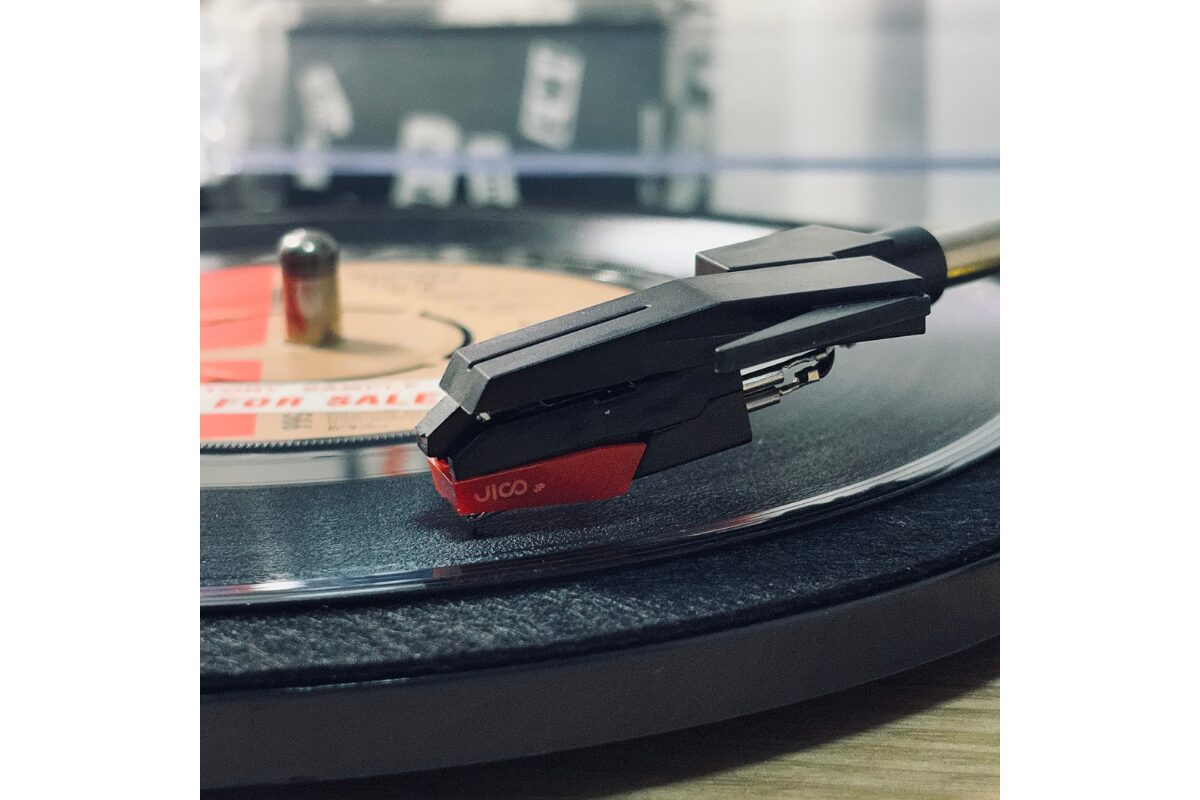
The ION Max LP is a record player valued for its ease of use straight out of the box.
When using it in everyday listening, it’s easy to appreciate how casually and comfortably it lets you enjoy records.
After using it for a while, however, you may start to wonder whether the sound could be improved slightly, or if there is anything simple you can do to make a small difference.
Building a full audio system often comes with higher hurdles, such as choosing components and securing enough space for installation.
With that in mind, this article looks at how much the sound changes when the replacement stylus on the ION Max LP is upgraded to a diamond stylus, based on hands-on testing.
I will also go through the replacement procedure, the differences compared with a sapphire stylus, and the cost, focusing on practical impressions from actual use.
I hope this will be helpful for anyone using an ION Max LP who is thinking about making a small improvement to their current setup.

About this article
In this article, I examine how much the sound changes when the stock sapphire stylus supplied with the ION Max LP is replaced with a diamond stylus, based on hands-on testing.
First, I summarise my initial listening impressions immediately after the replacement.
Next, I compare the sound using simple recorded audio samples.
After that, I outline the replacement procedure and the differences between the two types of stylus.
Sound impressions are, of course, subjective, but I hope this will be useful for anyone using an ION Max LP who is considering changing the stylus.
The stylus introduced in this article is shown below.
Availability may vary by region, so it is worth considering locally available alternatives with comparable specifications.
Sound changes after switching to a diamond stylus
For this listening test, I used the built-in speaker output of the ION Max LP.
Sound quality when using headphones or external speakers will be covered separately on another occasion.
To be honest, I did not expect a dramatic difference, but the change in sound was more noticeable than I had anticipated.
As soon as the record started playing, from the very first notes of the intro, it was immediately clear that something sounded different.
After switching to the diamond stylus, individual parts became easier to distinguish, and the overall sound felt clearer.
As a result, the performance also seemed to gain a bit more impact.
After listening with the diamond stylus, I switched back to the sapphire stylus and found myself thinking that it also had its own appeal.
The sapphire stylus offers a more cohesive sound, with a sense of liveliness that can suit certain records particularly well.
It was somewhat surprising how much the overall impression changed simply by replacing the stylus, even when listening to the same track.
That said, which one sounds better will ultimately come down to personal preference.
Personally, for anyone who wants to enjoy their records with slightly improved sound quality, I think trying a diamond stylus is worth considering.
If you are comfortable changing styli regularly, using the sapphire and diamond styli selectively depending on the record or your mood also feels like a reasonable option.
For reference, I also asked an acquaintance with a much better ear than mine—despite my own experience with music—to compare the two.
Their reaction was simply that the difference was clearly noticeable.
Listening comparison: sapphire stylus vs diamond stylus (with video)
About the recording setup
The listening comparison video was recorded using an iPhone 15.
The track used is “Anarchy in the U.K.” by the Sex Pistols.
Audio was recorded from the built-in speaker of the ION Max LP, from the same position and angle, to ensure that conditions remained consistent when switching between the sapphire and diamond styli.
No dedicated recording equipment or audio editing was used. The aim was simply to capture a sound close to what I normally hear when listening in the room.
As a result, there are aspects that may be easier or harder to distinguish in the video, but I hope it can serve as a reference for sensing the overall difference in character between the two styli.
What can and cannot be heard clearly in the video
What is easy to hear in the video
After reviewing the recorded video, I felt that the overall increase in clarity was relatively easy to notice.
After switching to the diamond stylus:
- Small surface noise (often described as light crackle) was reduced
- Individual parts of the music came forward and became easier to distinguish
These points, in particular, seem to come across to some extent even in the video.
That said, when it comes to overall clarity, depending on the playback environment, some listeners may feel that the difference is less obvious.
What is harder to hear in the video
There were also aspects that were harder to pick up in the video.
The difference in low-end weight, particularly in the bass line, was quite noticeable when listening in person, but it may be more difficult to convey clearly through the video.
Points to keep in mind when watching the video
As this was a simple recording made using a smartphone, some finer nuances may not come across fully.
However, it should still serve as a useful reference for getting a sense of the overall difference in character.
Comparison video
Below is a comparison video recorded under the same conditions, using the sapphire stylus and the replacement diamond stylus.
▼ Sapphire stylus
▼ Diamond stylus (4RB conical)
Replacing the stylus on the ION Max LP
Replacement procedure (with photos)
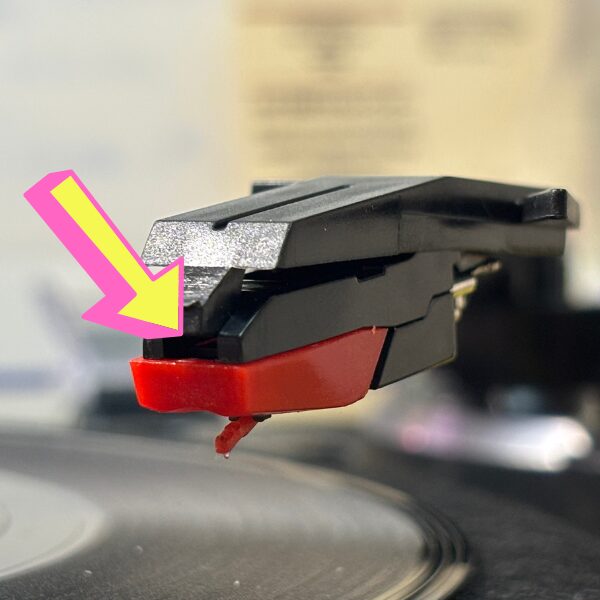
① Before replacement
This is the condition before replacing the stylus.
The red part indicates the stylus currently in use.
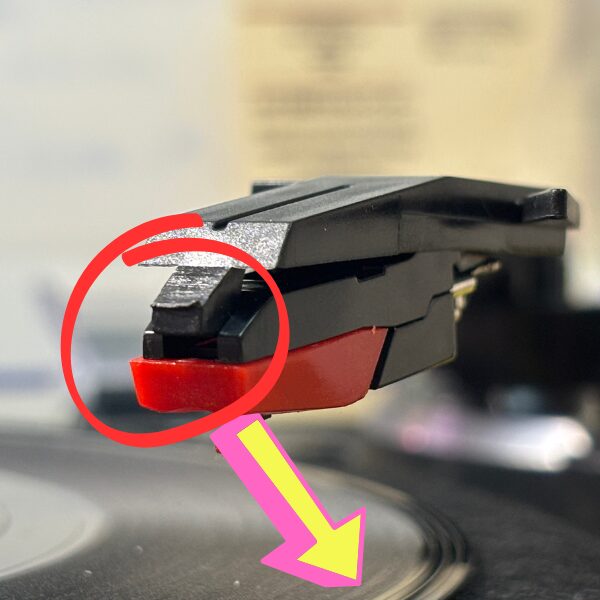
② Gently pull the stylus tip downward
Hold the black part firmly.
Gently pull the red stylus section diagonally downward.
No excessive force is required.
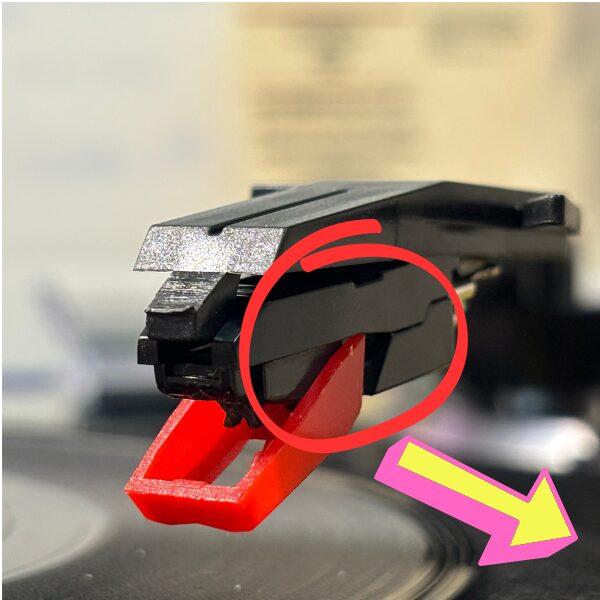
③ Pull it straight down
Continue pulling downward and the stylus will come off.
If it feels stuck, slightly widening the red circled area can make removal easier.
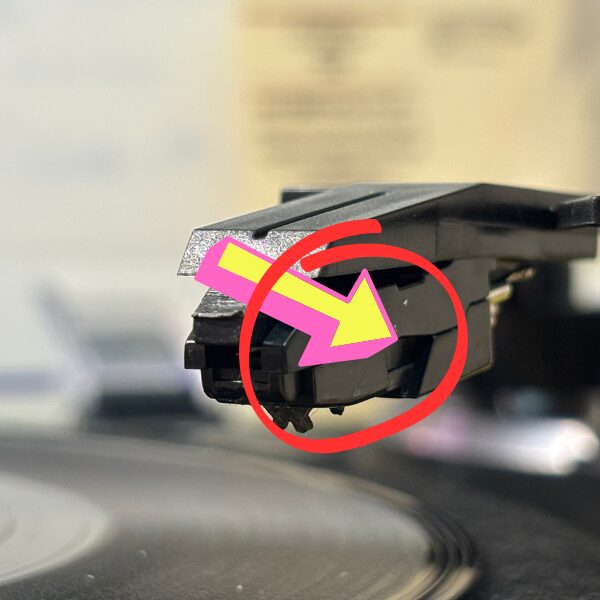
④ Stylus removed
This is the state with the stylus removed.
Be careful not to touch the cartridge itself.
To attach the new stylus, follow the above steps in reverse, starting from the red side.
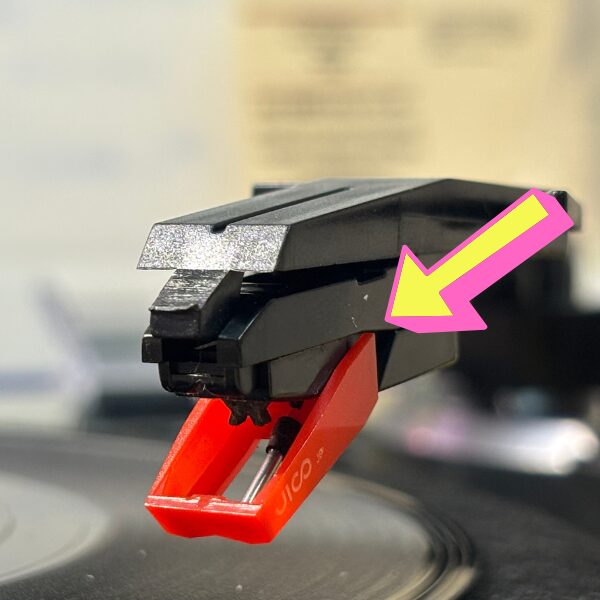
⑤ Insert the new stylus
Slide the new stylus inward until it clicks into place.
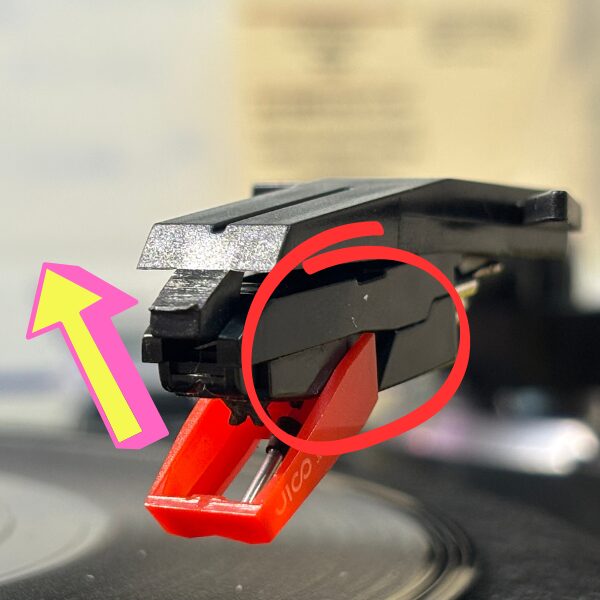
⑥ Raise the stylus guard
Be careful not to touch the stylus tip.
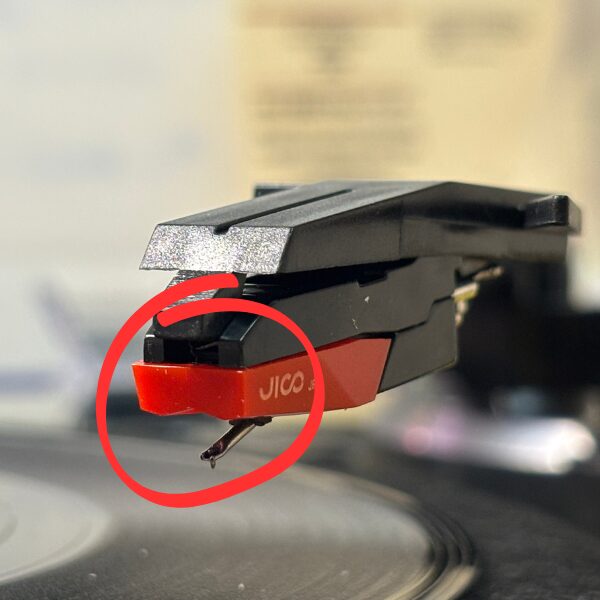
⑦ Installation complete
The installation is complete once the stylus is securely closed.
Note that in some cases, there may be no audible click sound.
Points to be careful about during replacement
Replacing the stylus itself was not difficult, but there were a few points I paid attention to during the process.
First, I made sure not to touch the cartridge body or the stylus tip directly.
The stylus tip is extremely delicate, and even slight contact can cause it to bend or become damaged.
Holding the black plastic section firmly felt like the safest approach.
In terms of force, there is no need to apply much pressure.
However, being overly cautious and pulling too gently can sometimes make it difficult to remove the stylus.
A light but confident pull seemed to work best.
I also took care not to lift or twist the tonearm unnecessarily.
Since the stylus can be replaced without moving the arm itself, avoiding extra force helps reduce the risk of damage.
General differences between sapphire and diamond styli
Here, I will summarise the commonly cited differences, such as materials and durability.
About the difference in materials
Sapphire styli are typically made from synthetic alumina.
Because the material is relatively easy to process and keeps costs down, sapphire styli have often been used in more affordable cartridges and simple record players.
Diamond styli, on the other hand, use diamond—a carbon crystal—as their material.
Thanks to its extremely high hardness and resistance to wear, diamond has become the standard choice for many cartridges today.
There are several types of diamond styli, including nude designs and versions where a diamond tip is bonded to a metal shank.
Differences in durability
Generally speaking, sapphire styli are said to wear more quickly than diamond styli.
Their expected usable lifespan is relatively short, and in many cases they are intended to be replaced more frequently.
Diamond styli, by contrast, are considered more durable and better suited to extended use, allowing for longer intervals between replacements.
For listeners who spend more time playing records or prefer to use the same stylus for longer periods, this difference in durability becomes an important factor.
General tendencies in sound quality
When it comes to sound characteristics, it is difficult to generalise, as the material of the stylus tip is only one factor.
The stylus shape and the overall cartridge design also have a significant influence.
That said, the following tendencies are often mentioned in general discussions.
Sapphire styli are often described as having a relatively softer sound, giving an overall more relaxed impression.
Because they do not emphasise fine detail too strongly, they can sound easier on the ear depending on the condition of the record.
Diamond styli, on the other hand, are commonly said to deliver a more defined sound, with greater clarity and detail.
Many listeners report noticing differences particularly in high-frequency openness and the attack of notes.
Cost and running cost considerations
Sapphire styli are attractive in terms of lower initial cost, but they tend to require more frequent replacement depending on usage time.
As a result, they suit short-term use or light listening, but the number of replacements may increase over longer periods.
Diamond styli are generally more expensive at the time of purchase, but their higher durability makes it easier to reduce both replacement effort and overall cost in the long run.
Choosing the right stylus depends on how you listen
Both sapphire and diamond styli have their own characteristics.
The right choice will differ depending on whether you want to keep the initial cost low for casual use, or prefer a more stable option for long-term listening.
Rather than thinking in terms of which is objectively better, it makes sense to choose based on your listening frequency and what you value most in everyday use.
Conclusion
Even if you are satisfied with the sound, styli are consumables
Even if you are satisfied with the sound of the ION Max LP, the stylus has a limited lifespan, and replacing it at appropriate intervals is gentler on your records.
This becomes especially important when playing records that you care about, as paying attention to the condition of the stylus helps protect them.
Final thoughts
After trying this in practice, my honest impression was that the change in sound was more noticeable than I had expected.
Simply changing the stylus made the same record sound surprisingly different, which really stood out to me.
Who may find a diamond stylus suitable
Based on this experience, a diamond stylus may suit listeners who:
- Prefer a more clearly defined sound
- Want to improve the sound quality even when using the built-in speaker
- Are interested in trying an easy, low-effort upgrade
If you’re looking for a UK-available alternative to the JICO 4RB CONICAL, this diamond stylus is a perfect match. It features a diamond tip and an aluminium cantilever, providing the same kind of sound upgrade I’ve discussed in this article. It’s a simple and effective way to get more out of your records.
Who may be fine with a sapphire stylus
On the other hand, if you are already satisfied with the current sound, there is no real need to rush into replacing the stylus.
Even with a sapphire stylus, as long as its condition is properly maintained, it is perfectly possible to enjoy listening to records.
In closing
Changing the stylus can alter the overall impression of the sound, but it is not a matter of one being right or wrong—it ultimately comes down to personal preference.
That may be part of what makes listening to records so interesting.
Thanks for reading.
This article contains affiliate links.
Related article:
Portable Record Player “ION Max LP” Review:
Why It’s a Good Choice for a First Turntable
👉Read the ION Max LP review here.
For collectors interested in Japanese editions
If you are drawn to the design and information found on Japanese releases, particularly obi strips, you may want to take a look at my Never Mind The Bollocks Japanese CD OBI Gallery.
This page organises each obi strip variation issued for the album individually, presenting the obi itself as the main focus in a collector-oriented reference format.
It is intended as an entry point for those interested in Japanese obi strips.



コメント